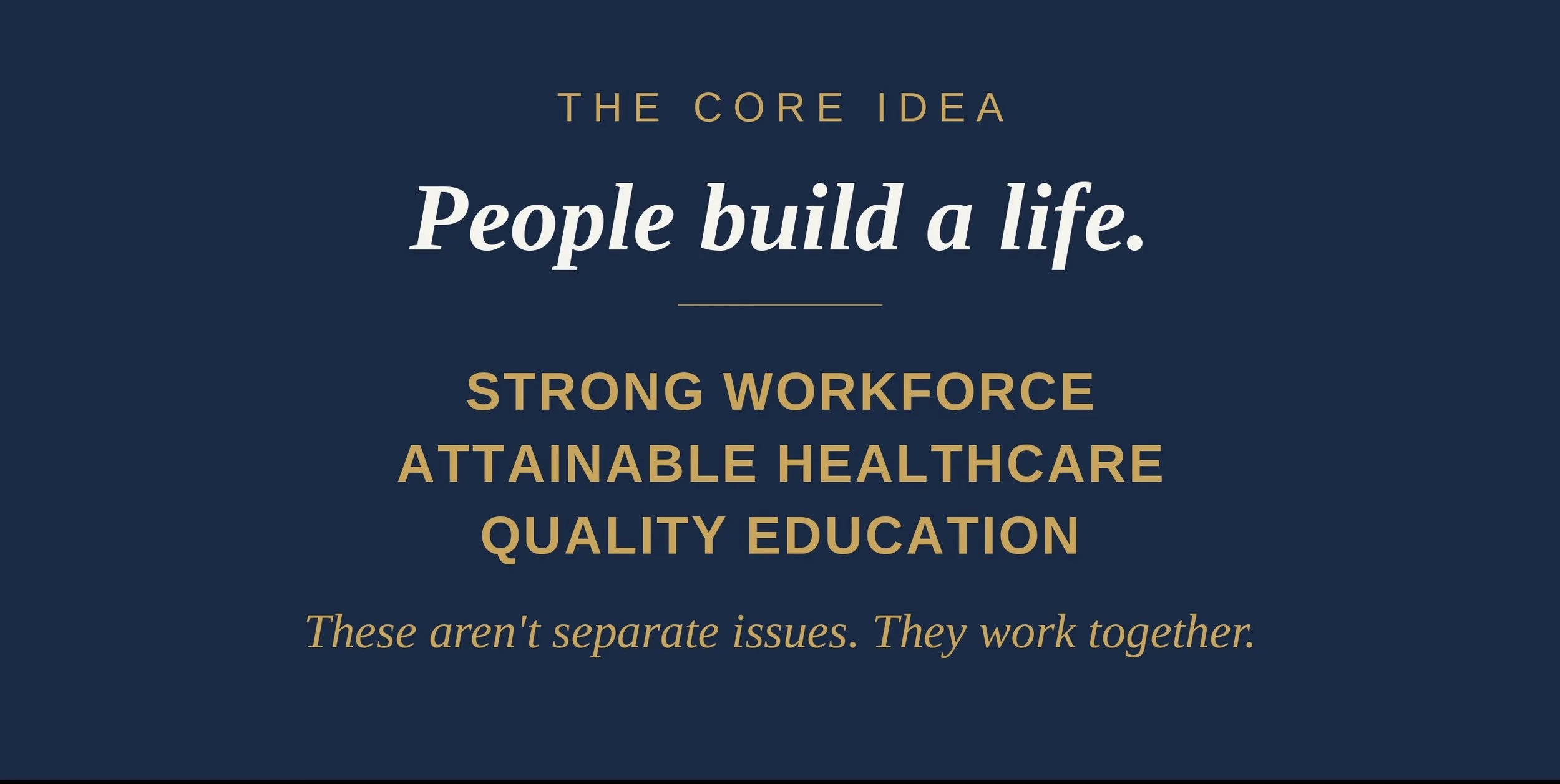
These are the issues I've spent my career working on and the priorities I'll bring to Bismarck.
Dr Shelley serves on the Southwest Career & Technical Education Healthcare Advisory Board.
I've spent more than twenty-five years hiring employees in western North Dakota. These ideas come from what I've learned as an employer.
STRONG WORKFORCE
People stay when they can build a life.
I've spent more than twenty-five years hiring and keeping good people in western North Dakota. I know what it costs when someone leaves—not just for an employer, but for the patients, students, coworkers, and neighbors who depend on them.
The workforce challenge in District 37 isn't a mystery--it's math. When the total package — wages, healthcare, housing, childcare, schools — doesn't add up to a life someone can build here, they leave. They don't leave because they want to. They leave because the numbers don't work.
Oil has created real opportunity in this region. It's also made every other employer compete harder for the same talented people. A teacher, a welder, a nurse, a mechanic — every one of them has options. Our job is to make staying here the obvious choice.
Recruit and Retain the People Our Communities Depend On
Compensation matters, but salary alone isn't the whole story. A raise that disappears into insurance premiums isn't really a raise. That's why workforce and healthcare are connected in my platform — because a teacher or a nurse who can afford their family's healthcare is more likely to stay.
For skilled trades, the goal isn't to out-pay the oilfield. It's to build careers that offer stability, purpose, and a future — and to make sure young people know those careers exist before they graduate.
Connect Students to Careers
As a member of the Southwest Career & Technical Education Healthcare Advisory Board, I've watched students discover careers they never knew existed. Some have shadowed at my clinic, entered training programs, and joined our workforce. That pipeline works — when it's funded and when every student has access to it.
I'll work to strengthen and stabilize SWCTE so those opportunities reach every student in our region, not just those who happen to live nearby.
Housing and Childcare are Workforce Infrastructure
You can recruit someone to Dickinson. Housing and childcare are workforce infrastructure. People can't accept a job—or keep one—if they can't find a home they can afford or reliable care for their children.
Housing has to be addressed from both directions: reducing unnecessary building costs and improving access for working families who can afford a mortgage but can't save a down payment. Programs through the Bank of North Dakota and the Housing Incentive Fund can help that missing middle.
Childcare is the same. A tax credit doesn't help a family if there's no open slot to use it on. We need more capacity and more affordability — and we need to be honest about which employers and families current tools actually reach.
Every employee who stays strengthens a family, a business, and our community.
I buy my own health insurance every month. I know firsthand what rising healthcare costs mean for working families and small businesses.
ATTAINABLE HEALTHCARE
Healthcare costs are rising faster than wages, school budgets, and family finances. North Dakota can do better.
I pay more than $1,200 a month for my own health insurance — and I still have an $8,000 deductible. I understand this problem because I live it.
Whether you're a teacher, police officer, rancher, or small business owner, healthcare costs are rising faster than wages and family budgets. This isn't a partisan problem. It's a math problem.
Healthcare costs in North Dakota are rising faster than any of our existing budget structures were designed to handle. And it shows up differently depending on who you are.
You're a teacher who got a 2.5% raise that was eaten alive by a 15% premium increase. You're a 58-year-old ranch hand or small business owner who makes too much for Medicaid but can't afford $1,500 a month until Medicare kicks in at 65. You're a city trying to retain a police officer while healthcare costs outpace your property tax cap.
Protect Public Employees
School districts receive modest increases in state funding while insurance premiums can jump dramatically in a single year. A raise that disappears into insurance premiums isn't really a raise. I'll pursue a legislative healthcare trigger that reviews school funding whenever employee healthcare costs rise significantly beyond expectations — so salary increases stay real.
I'll also explore a Prescription Drug Affordability Board for state-funded health plans. Specialty drug costs are one of the fastest-growing drivers of premium increases. Using North Dakota's purchasing power wisely can slow that growth and protect the independent pharmacies that rural communities depend on.
Bridge the Gap to Medicare
Federal law allows insurers to charge older adults up to three times more than younger adults for the same coverage. By the time many North Dakotans reach their 50s and early 60s, insurance has become one of their largest monthly expenses.
I'll explore using a small fraction of Legacy Fund earnings — not the principal, no new taxes — to provide a temporary, income-based premium bridge for North Dakotans ages 55 to 64 who purchase their own insurance. This isn't a permanent entitlement. It's a targeted bridge that sunsets automatically at Medicare eligibility.
Help Small Businesses Offer Health Insurance
North Dakota already runs a reinsurance program that saved policyholders $88 million from 2021 to 2023. The problem is it barely reaches small businesses and the self-employed. Adjusting how it works can extend those savings to the people in our district who need it most — no new program required.
There's also a legal tool most small employers have never heard of — an ICHRA — that lets employers give workers tax-free money to buy their own insurance. Our existing Small Business Development Centers and Extension offices can help employers use it. Low cost. Real impact.
Healthcare is a workforce issue, a small business issue, and a family issue. North Dakota has the tools to make it more attainable—we just need to use them wisely.
I've served as a school board president, mentored students, and worked with career and technical education programs across western North Dakota.
QUALITY EDUCATION
An educated community is a thriving community.
My father was raised in Germany during World War II. Growing up, one of the most important lessons I learned from him was this:
“The only things you truly possess are what your head and your hands can do. No one can take those away from you.”
Education isn't about producing one kind of graduate. It's about helping every person discover the path that's right for them and preparing them to think, solve problems, adapt, and contribute. Whether that path leads to a university, the skilled trades, an apprenticeship, or another career, every student deserves the opportunity to succeed.
Support the People Who Teach
Teachers are one of North Dakota's most valuable workforce investments. Recruiting great teachers — and keeping them in western North Dakota — has become increasingly difficult.
Compensation matters. But as I've seen firsthand, a raise that disappears into insurance premiums isn't really a raise. That's why my education and healthcare priorities are connected — because a teacher who can afford their family's healthcare is more likely to stay.
Teachers also need more support inside the building. The most consistent concern I hear is that teachers are being asked to teach, counsel, advise, and manage growing mental health needs — all at once. I support expanding access to dedicated career counselors and school social workers so teachers can focus on what they do best: teaching.
Invest in School Infrastructure
A school's building says something about what a community believes its children deserve.
North Dakota is fortunate to have extraordinary financial resources. Yet many rural communities still struggle to maintain school facilities because construction depends heavily on local property taxes and bond measures. Large communities may be able to pass a bond. Many smaller communities cannot.
No district should have to choose between repairing a leaking roof and attracting excellent teachers. North Dakota should assume a greater share of responsibility for school infrastructure — particularly in rural districts — using the resources we've built together to invest in the next generation.
Connect Education to Careers
This is one of the issues I'm most passionate about.
Right here in Dickinson, SWCTE's program works with 36 local businesses. Students shadow real professionals, earn certifications, and graduate with a foot in the door of careers that matter and they are excited about. A 16-year-old sophomore recently became a certified nurse aide through that program. A senior is heading to train as a dental hygienist. These aren't statistics — they're neighbors building a future here.
That pipeline works. When it's funded, when it's supported, and when every student has access to it — regardless of where they live or whether they have reliable transportation.
I'll support stable funding for SWCTE, better transportation for rural students, expanded work-based learning, and stronger partnerships between schools and local employers. Career exposure matters as much as technical training. Young people thrive when they can see a future for themselves.
Education is where strong communities begin. When students can discover their strengths, teachers have the support they deserve, and schools connect learning to real opportunities, North Dakota keeps more of its talent close to home.
That's the future I want to help build.
Want to talk issues, volunteer, or put up a yard sign? Call me directly at [701-354-3907] — I answer my own phone.